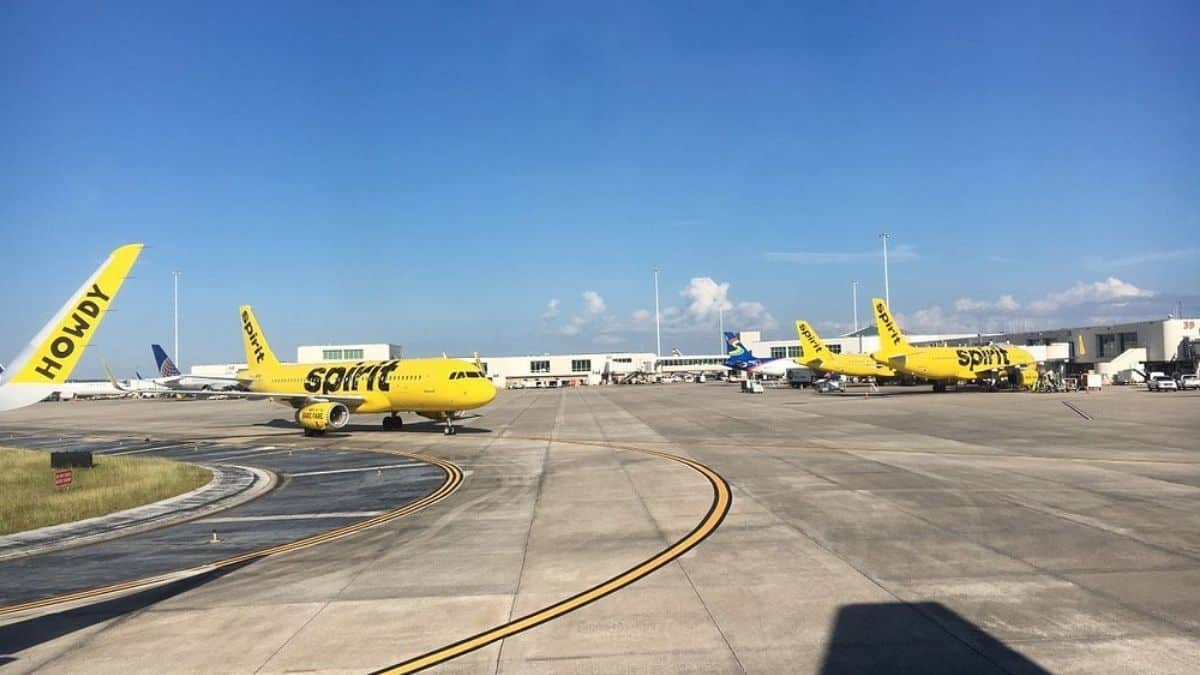
News that Spirit Airlines may be preparing to shut down has sparked a lot of conversation, and for good reason. Reports indicate the airline had been in talks for a $500 million financial lifeline from the Trump administration, but negotiations fell apart amid investor concerns and political pushback.
Whether people loved the airline or avoided it completely, Spirit played a much bigger role in the travel industry than most realize.
For decades, Spirit helped reshape how Americans travel by forcing competition. When Spirit entered a market, prices dropped, almost instantly. That impact wasn’t subtle, it was industry-wide. Even travelers who never stepped foot on a Spirit flight benefited from lower fares across the board.
Article Contents
The Reality of Low-Cost Competition
Spirit was one of the last true ultra low-cost carriers in the United States. While airlines like Southwest Airlines and JetBlue Airways were once considered budget-friendly, their pricing today often aligns closely with legacy carriers like Delta Air Lines, United Airlines, and American Airlines.
That leaves airlines like Frontier Airlines as one of the only remaining players in that true low-cost space.
And that matters.
Because when there’s less competition at the bottom of the market, prices don’t just stay the same, they rise.
Spirit’s Model: A Gift and a Curse
Spirit’s business model was simple in theory: offer the lowest base fare possible, then charge for everything else. For some travelers, that worked perfectly. If all you needed was a backpack and a seat from point A to point B, Spirit made travel accessible in a way that traditional airlines didn’t.
But the execution created problems.
The constant add-ons, bag fees, seat selection charges, and strict policies often left travelers feeling like they were being nickel-and-dimed. That frustration didn’t just stay online, it showed up at the airport. Frontline staff were left dealing with upset passengers daily, which created a cycle of tension that became part of the airline’s reputation.
And once a brand becomes associated with conflict, it’s hard to reverse.
Performance Wasn’t the Main Issue
Spirit wasn’t perfect, but it also wasn’t as unreliable as many people think. Its on-time performance has improved significantly in recent years, sitting just slightly behind airlines like Delta Air Lines.
The bigger issue was financial pressure. Rising fuel costs, increased competition, and operational challenges like engine defects and post-pandemic recovery all weighed heavily on the airline. Even after filing for bankruptcy more than once, long-term stability remained uncertain.
What This Means for Black Travelers
This is where the conversation hits differently.
For many Black travelers, Spirit wasn’t just another airline, it was an entry point into travel. Lower fares made it possible to take trips that might not have otherwise been within reach.
That matters.
Historically, access to travel hasn’t been equal. When affordable options disappear, it disproportionately affects communities that already face financial barriers to travel.
So while some may celebrate the potential shutdown, there’s a real impact to consider. Fewer low-cost options could mean fewer opportunities for people to explore, connect, and experience the world.
The Bigger Picture
Spirit likely needed to evolve. A clearer pricing structure, better customer experience, and a shift in how it communicated value could have changed its trajectory.
But its role in the industry can’t be ignored.
If Spirit does shut down, the biggest takeaway isn’t just the loss of an airline, it’s the loss of pressure on the entire system to keep prices competitive.
And that’s something every traveler will feel.