
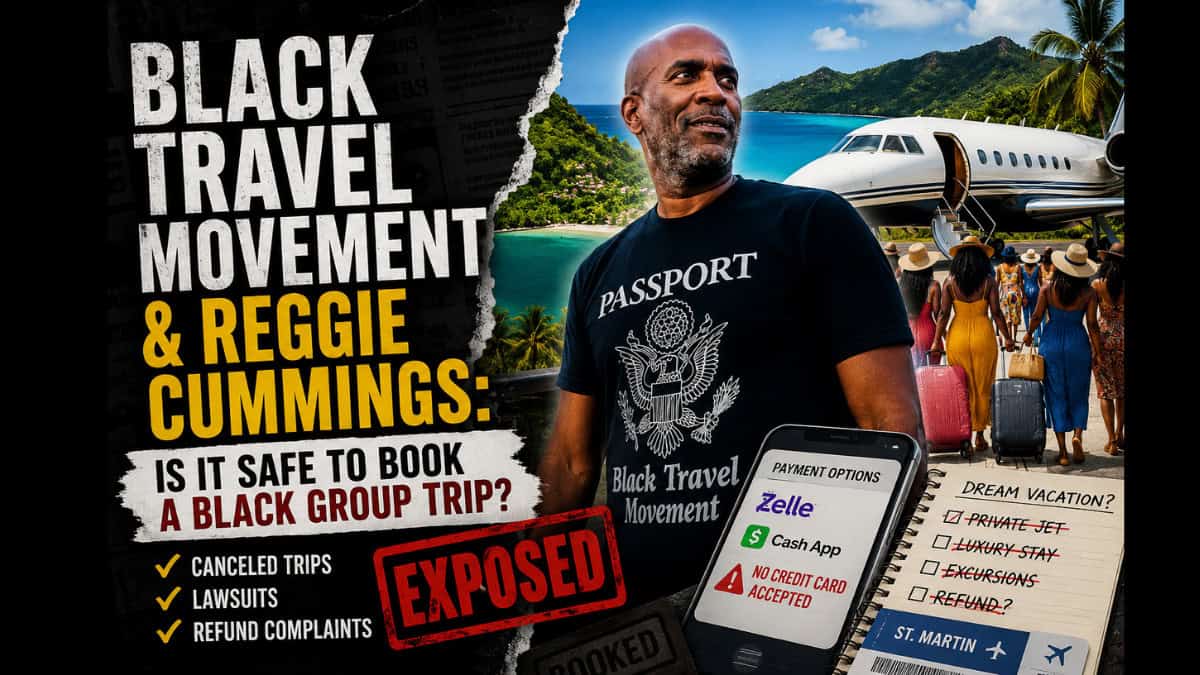
If you’ve been on social media recently, you may have seen The Shade Room’s investigation into Black Travel Movement and its founder, Reginald “Reggie” Cummings.
Black Travel Movement has built one of the largest online communities centered around Black travel, with its Facebook presence reaching hundreds of thousands of people. The company also emerged during a period when Black travel was becoming increasingly visible online, fueled by Facebook groups, Instagram pages and travel communities showing Black people exploring destinations around the world.
And the economic impact is real. Research from MMGY Global estimated that Black U.S. leisure travelers spent more than $100 billion on travel in 2019.
But the recent allegations surrounding Black Travel Movement also raise a larger question that we think Black travelers should be talking about:
When you book a group trip you found on social media, how do you know your money is actually protected?
The Private Jet Trip That Caught Our Attention
Here at Black People Vacation, we had seen Black Travel Movement promote its private jet experience before the recent controversy.
And we’ll admit: it was an interesting concept.
Private aviation is prohibitively expensive for most individual travelers. But divide the cost of a charter among a group, package it with accommodations and experiences, and suddenly you’re offering travelers access to something they may never purchase on their own.
That’s part of what makes group travel so appealing. A good tour operator can use the buying power of a group to create experiences that would otherwise be difficult or expensive to arrange individually.
According to The Shade Room’s recent investigation, travelers booked a St. Martin experience that included a one-way private jet from Miami, accommodations and other activities. One couple interviewed said they paid a combined $9,700.
The trip was ultimately canceled.
Cummings told The Shade Room that he had been defrauded by someone he believed was a legitimate private jet broker. He said he was also financially harmed by the alleged fraud and has accepted responsibility for reimbursing the affected travelers. In his statement to The Shade Room, Cummings said 10 of 14 travelers had already been fully reimbursed and that he intended to reimburse the remaining travelers.
Those claims and allegations are still important to distinguish from established facts.
But something about the story immediately stood out to us as travel professionals.
Who Had the Travelers’ Money?
This is the question travelers should be asking long before anything goes wrong.
A travel advisor and a tour operator aren’t necessarily functioning the same way.
With many traditional travel agency bookings, your travel advisor doesn’t actually receive your vacation money. The agency obtains authorization to charge your credit card, and the hotel, cruise line, tour operator or other travel supplier processes the payment directly.
There are situations, particularly with groups and custom packages, where an agency or tour operator may need to collect money directly. For example, four friends might each pay their portion of a private transfer while the transportation company requires one payment from the group organizer.
That isn’t automatically a red flag.
How the company accepts that money, however, matters.
One thing that previously caught our attention about Black Travel Movement was its promotion of payment methods such as Zelle and Cash App.
At Black People Vacation, we don’t accept Zelle or Cash App for vacation payments.
Why?
Because paying a travel company isn’t the same thing as sending $40 to your cousin for dinner.
Credit cards provide consumers with protections and a mechanism for disputing charges when something goes seriously wrong. Peer-to-peer payment services generally don’t provide the same protections simply because a customer later becomes unhappy with a purchase.
If a travel company needs to collect your money directly, that alone isn’t necessarily concerning.
But you should still be asking: Can I pay by credit card?
This Isn’t Black Travel Movement’s First Public Dispute
The recent St. Martin situation also isn’t the first time Cummings and Black Travel Movement have faced questions over a group trip.
In 2019, hundreds of travelers participated in Black Yacht Week in the British Virgin Islands.
The trip was promoted as a luxury experience with yachts, professional crews, meals, drinks and other amenities. Travelers later complained about mechanical problems, inadequate provisions and an experience that they said didn’t resemble what had been advertised.
At the time, Cummings blamed yacht charter company Dream Yacht America, arguing that the company had failed to provide the services Black Travel Movement purchased.
Dream Yacht told a very different story.
The charter company alleged that Black Travel Movement had paid only a $60,000 deposit and failed to pay more than $500,000 remaining for the yachts, staff and provisions. Litigation followed, and a federal judge ultimately entered a judgment of more than $1.6 million against Cummings and Black Travel Movement.
That history makes the questions surrounding the latest canceled trip particularly important.
This Is Bigger Than One Travel Company
And this is where we want the conversation to go beyond Reggie Cummings.
There has been an explosion of Black travel groups over the last decade, and overall, we think that’s a great thing.
People naturally enjoy traveling with communities where they feel comfortable. Black travelers have created spaces where we can find each other, travel together and experience destinations without always being the only Black person in the room.
But a large Facebook group does not necessarily mean a company has a strong balance sheet.
A beautiful Instagram page doesn’t tell you how customer deposits are managed.
And 100,000 followers don’t tell you whether a business has enough working capital to survive when something goes wrong.
That distinction matters because operating group trips can require substantial amounts of money.
Hotels want deposits. Transportation companies want deposits. Charter companies want deposits. Some suppliers require final payment months before travelers ever arrive.
Meanwhile, travelers cancel. Suppliers change terms. Flights get disrupted. Currency values change. Vendors sometimes fail.
A properly structured travel business plans for those possibilities.
If a company’s entire operation depends upon money from the next group of travelers coming in to pay obligations from an earlier trip, one disruption can create a financial crisis very quickly.
We’re not saying that’s what happened in any particular case. We’re saying that’s exactly why the financial structure behind the company you’re paying matters.
We’ve Seen This Story Before
Black Travel Movement isn’t the only group-travel business to make headlines after things went wrong.
In 2023, travelers with Nurses Travel Network said they had paid for excursions and amenities associated with a Mediterranean Virgin Voyages sailing that they ultimately did not receive.
Virgin Voyages told FOX 26 Houston that it made multiple attempts to obtain payment from the organizer for shore excursions. According to Virgin, after payment wasn’t received, the excursion inventory was released.
Nurses Travel Network subsequently announced that it was permanently closing its operations.
In 2024, another company, Ladies and Luggage, which specialized in group travel for Black women, abruptly shut down and canceled upcoming trips. Customers interviewed by Atlanta’s WSB-TV said they were owed thousands of dollars.
Owner Dacia Woods said she intended to make customers whole and attributed the company’s financial problems in part to predatory loans, a tax lien and the departure of a business partner. Her attorney maintained that customer money had not been spent inappropriately.
Different companies. Different circumstances. Different explanations.
But for travelers, there’s a common lesson:
You need to know who you’re giving your money to.
Before You Send Thousands of Dollars, Do Your Homework
We understand why travelers sometimes skip this part.
You join a Facebook group with hundreds of thousands of members. You’ve watched people travel with the company for years. You see pictures from Dubai, Ghana, Greece and Bali. People in the comments are excited. Maybe your friend has even traveled with them before.
Everything feels legitimate.
But before sending thousands of dollars to any travel company, take another 20 minutes.
Search the company’s name and the owner’s name on Google.
Look at Google reviews.
Check the Better Business Bureau.
Search Facebook.
Search TikTok.
Search Reddit.
And don’t only search “[Company Name] reviews.” Try “[Company Name] refund,” “[Company Name] complaint,” “[Company Name] canceled trip” and “[Owner’s Name] lawsuit.”
You’ll be surprised what you can find.
Then look at how you’re being asked to pay.
If someone wants thousands of dollars through Zelle, Cash App or another peer-to-peer transfer service, ask why you can’t use a credit card.
Find out who’s actually operating the trip. Ask what happens to your money if the trip doesn’t meet its minimum number of travelers. Read the cancellation terms before paying, not after something goes wrong.
And consider travel insurance, while understanding exactly what the policy does and doesn’t cover. Travel insurance isn’t a substitute for doing business with a financially responsible company.
Supporting Black Businesses Doesn’t Mean Skipping Due Diligence
We want Black-owned travel businesses to thrive.
We want Black travelers creating companies, leading groups around the world and building businesses from the billions of dollars our community spends on travel.
But supporting Black businesses and protecting yourself financially are not competing ideas.
You can do both.
In fact, expecting Black travel companies to operate with strong financial controls, clear contracts, appropriate insurance, transparent payment practices and professional standards is part of supporting the growth of the Black travel industry.
Community is powerful.
But community isn’t consumer protection.
Before you book the next amazing group trip that appears on your timeline, enjoy the pictures, read the itinerary and get excited about the destination.
Then do one more thing.
Follow the money.